
Understands Creative Intent
Interprets what you want to communicate, who it is for, and what the creative needs to achieve before generation begins.
StudioRoom's AI Creative Engine is the intelligence layer that connects ideas, brand context, creative direction, AI models, assets, and production workflows into one connected system.
Instead of treating AI generation as a simple prompt-to-output interaction, the engine considers what you are trying to create, why you are creating it, what the creative needs to communicate, and how the resulting output needs to work within the larger production process.
It brings intelligence closer to the point where creative work actually happens — helping transform creative intent into structured directions, generated outputs, adaptations, and production-ready assets.

KEY TAKEAWAYS
StudioRoom's AI Creative Engine sits underneath specialised studios and production workflows. It interprets creative intent, applies brand context, coordinates models and assets, and keeps decisions connected from the first idea through to production-ready output.
Interprets what you want to communicate, who it is for, and what the creative needs to achieve before generation begins.
Uses brand guidelines, visual language, messaging, and references so outputs stay aligned with your identity.
Helps translate an idea into visual directions, structures, and decisions instead of treating generation as a one-shot prompt.
Connects different AI capabilities to the requirements of each task across ideation, generation, and adaptation.
Provides the intelligence layer behind StudioRoom's specialised creative production workflows.
Uses products, people, references, logos, and other creative assets as meaningful inputs to production.
Enables teams to explore multiple creative directions instead of committing to the first generated result.
Keeps the relationship between the original idea, creative direction, and resulting outputs connected.
From understanding the idea to orchestrating the output, the AI Creative Engine connects the intelligence required to turn creative intent into production.
FROM PROMPT GENERATION TO CREATIVE REASONING
Traditional generative AI interactions often begin and end with a prompt. You describe something, the model generates something, and the creative team decides what to do next.
That approach can work for isolated experimentation, but professional creative production involves considerably more context.
A creative request can contain a product, audience, brand identity, campaign objective, visual reference, communication goal, format, channel, and production requirement. The same instruction can therefore lead to very different creative outcomes depending on the context surrounding it.

The initial instruction provides the starting point for the creative requirement.
Additional information gives the instruction meaning — including brand, product, campaign, audience, assets, and format.
The system connects the different requirements and determines how they relate to the creative task.
The creative requirement becomes a more defined visual and production direction.
Appropriate AI capabilities are applied to create the required output.
The resulting creative can move into refinement, adaptation, and broader production workflows.
This creates a more structured relationship between human creative intent and AI generation.
THE INTELLIGENCE LAYER BEHIND STUDIOROOM
StudioRoom is built as a creative production system rather than a collection of disconnected generation tools.

Understands what needs to be created and the purpose the final creative needs to serve within the broader communication.
Understands the brand's identity, visual language, and creative rules to keep production aligned with established brand direction.
Understands the intended visual direction, communication style, and creative approach that should shape the resulting output.
Understands the role of supplied products, references, and creative assets and how they should contribute to the final production.
Connects the capabilities required for the task and orchestrates the appropriate AI generation processes around the creative requirement.
Understands where, how, and in what format the final creative will be used so the output is developed for its intended purpose.
Creative production does not happen in one format.

A brand may need a product image today, an advertisement tomorrow, a campaign storyboard next week, and a complete set of social adaptations after that.
Each output has different requirements, but the underlying creative intent can remain connected.
The AI Creative Engine allows StudioRoom to apply intelligence across different production scenarios without forcing every creative task into the same workflow.
CREATIVE DIRECTION BECOMES PART OF THE SYSTEM
Creative direction is what transforms a generic output into an intentional visual.
It determines how an idea should feel, what the audience should notice, how elements should relate to one another, and what visual language should define the final result.
StudioRoom treats creative direction as part of the generation process rather than something that happens entirely before or after it.
The AI Creative Engine can work with multiple creative dimensions to shape the output.
Define the overall aesthetic character of the creative, establishing the visual language and personality of the final output.
Determine how the primary visual elements are arranged, creating structure, hierarchy, balance, and flow within the composition.
Establish the primary point of attention, ensuring the most important subject or message receives the strongest visual emphasis.
Build the contextual setting around the subject or product, defining the space, atmosphere, and visual world in which it exists.
Shape the atmosphere, depth, emphasis, and mood of the creative through intentional lighting direction and treatment.
Use colour relationships that reinforce the creative direction while remaining aligned with the brand context and intended visual mood.
Integrate typography, graphic elements, and communication components where relevant, ensuring they work as part of the overall visual system.
Use supplied visual references to establish the intended creative territory, helping guide the aesthetic, composition, treatment, and overall visual expression.
CREATIVE DIRECTION
Creative direction therefore becomes part of the system itself — connecting the idea with the decisions that determine how that idea should visually exist.

POWERED BY CONTEXTUAL INTELLIGENCE
Creative AI becomes more useful when it understands more than the immediate instruction.
StudioRoom can work with different forms of contextual information to help shape production.
That context can include brand guidelines, uploaded assets, reference imagery, product information, creative briefs, campaign requirements, content direction, and other inputs relevant to the task.
The AI Creative Engine brings these signals together so the generation process can operate within a defined creative environment.

Define the colours, typography, tone, visual language, positioning, and other brand requirements that should shape the creative output.
Understand the product's appearance, attributes, use cases, packaging, and distinctive visual characteristics that need to be represented accurately.
Establish the campaign idea, target audience, communication objective, messaging, and creative territory that guide the visual direction.
Incorporate uploaded images, logos, references, and other supplied materials according to their intended role within the creative.
Account for the dimensions, placement, platform, and output requirements that determine how the final creative needs to be composed.
Understand the current stage of production and the next action required to move the creative from its present state toward completion.
CONTEXT IS MORE THAN INFORMATION

Similarly, a brand guideline is not simply a document to reference. Its colours, typography, visual language, messaging principles, and usage requirements can influence how creative assets are developed.
The same applies to uploaded assets.
A product photograph may need to remain visually accurate.
A reference image may communicate mood or composition.
A logo may need to preserve its identity.
A campaign image may establish an existing visual direction.
A document may define rules rather than visual content.
The AI Creative Engine brings these different types of information into the production context rather than treating them as interchangeable inputs.
THE ENGINE BEHIND STRUCTURED CREATIVE WORKFLOWS
An intelligent creative system needs more than generation capability.
It needs workflow logic.
StudioRoom structures creative production into workflows that guide users through the decisions required to create a particular type of output.
The AI Creative Engine provides intelligence throughout these workflows.
A workflow can begin with a simple creative brief and progressively introduce the information required to develop the final output.
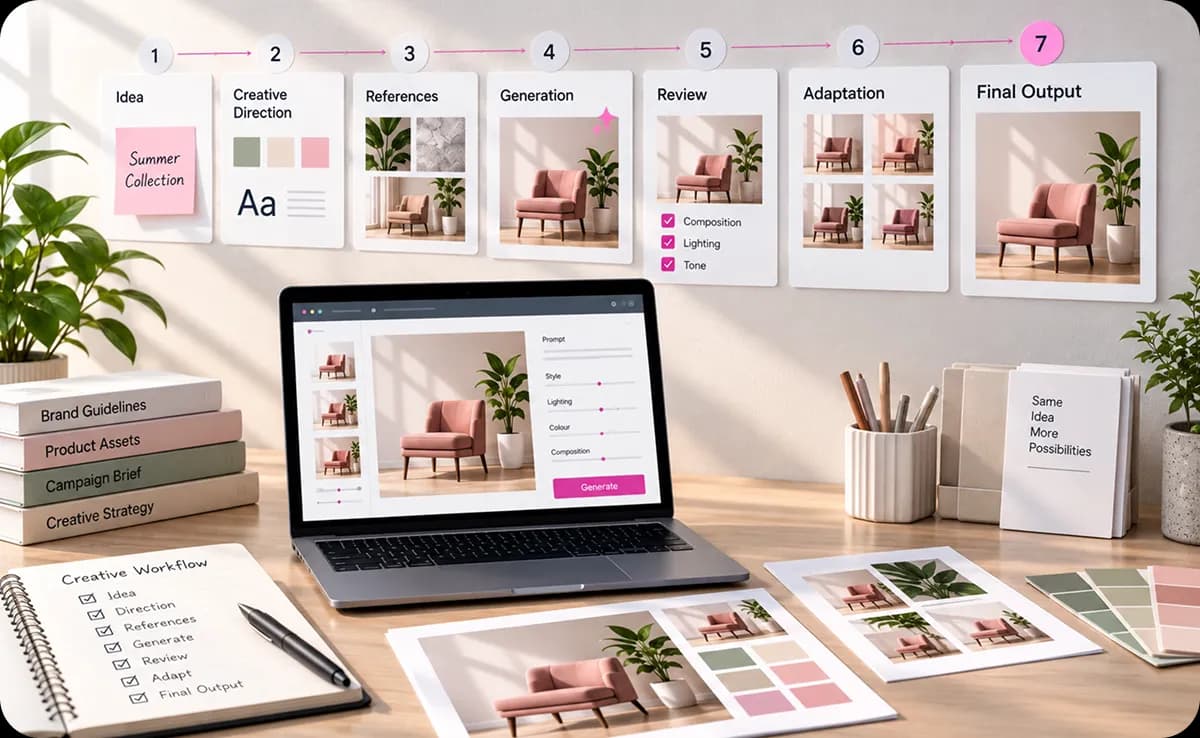
A Connected Creative Workflow
The starting point for the creative requirement.
The visual and conceptual direction that gives the idea form.
Existing assets and references that inform the intended output.
The arrangement, hierarchy, and structure of the creative.
Creation of the initial visual output.
Evaluation of the generated direction against the creative requirement.
Extension of the selected direction into additional requirements.
Transform an initial thought, brief, or creative objective into multiple possible directions that can be explored and developed.
Explore the visual, conceptual, and communication territory around an idea to establish a stronger creative direction.
Turn an approved creative direction into the required visual assets through structured generation and production workflows.
Translate an established creative direction into additional formats, dimensions, placements, and communication requirements.
Build additional content and creative assets from an existing direction while maintaining consistency across the broader system.
Continue developing the creative through iteration, creative decisions, and feedback until the direction is ready for final production.
FROM ONE IDEA TO A COMPLETE CREATIVE SYSTEM
The first creative interpretation is not always the final one.
Creative teams often need to explore multiple possibilities before they know which direction should move into production.
The AI Creative Engine supports this exploratory stage by helping teams generate different interpretations around a shared idea.
One product concept could be explored through:

An individual generation can solve a single problem.
A connected creative system can support a broader production requirement.
StudioRoom is designed for that shift.
For example, a product campaign can begin with one core creative direction and expand into:

INSTEAD OF ASKING:
“What image should we create?”

TEAMS CAN ASK:
“What creative system should we build around this idea?”
THE ENGINE ORCHESTRATES. THE STUDIOS SPECIALISE.
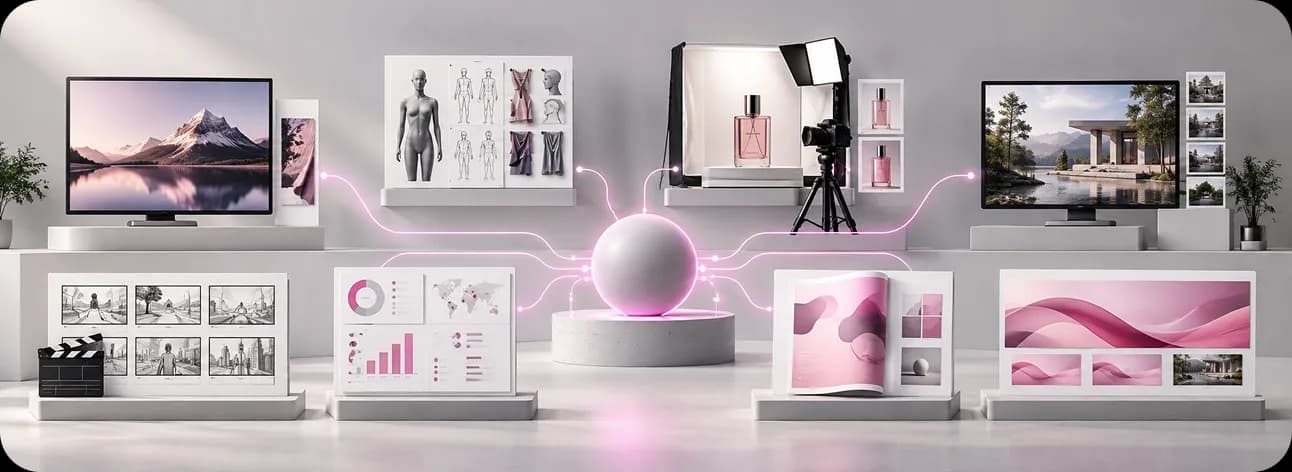
StudioRoom contains specialised Studios because different creative problems require different workflows.
The AI Creative Engine provides the common intelligence layer while each Studio focuses on its specific production requirement.
This creates a balance between centralised intelligence and specialised execution.
For structured visual creation, creative exploration, and developing multiple visual directions from an initial idea.
For developing character identities, appearances, styling, environments, and visual scenarios with greater creative control.
For product-focused visual development, presentation, and creating context-driven product imagery.
For creating immersive environments, settings, and contextual visual worlds around a creative concept.
For developing visual narratives, structured scene sequences, and connected storytelling directions.
For transforming information, data, and ideas into structured and engaging visual communication.
For developing print-focused advertising creative across posters, promotional materials, and other print formats.
For producing structured banner and display creative across campaign formats, placements, and communication requirements.
DESIGNED FOR HUMAN CREATIVE CONTROL
Creative production is not simply a technical problem.
It involves taste, judgement, context, strategy, and decisions about what should exist in the first place.
StudioRoom therefore positions AI as a creative production partner rather than an autonomous replacement for creative direction.

The creative requirement begins with a human objective, idea, brief, or communication need.
Brand information, product information, references, campaign requirements, and other context help establish what the creative needs to achieve.
Teams can explore different possibilities and decide which direction should move forward.
Generated creative can be evaluated against the original objective, visual direction, brand context, and production requirements.
The final creative direction remains part of the human decision-making process.
FROM CREATIVE BRIEF TO PRODUCTION INTELLIGENCE
A creative brief contains more than a description of an asset.
It can contain the reason behind the asset.
It may define the audience, objective, message, product, campaign, visual direction, and intended outcome.
The AI Creative Engine helps translate that information into inputs that can support production.

A brief can become:
Extension of the selected direction into additional requirements.
A CREATIVE BRIEF MIGHT SAY:

The AI Creative Engine helps bridge the gap between strategic intent and creative execution.
It connects what the brief is trying to achieve with the production decisions required to make that objective visual.
BUILT FOR EXPLORATION, ADAPTATION AND SCALE
Creative exploration and production scale can sometimes pull in opposite directions.
Exploration encourages experimentation.
Production requires consistency.
StudioRoom is designed to support both.
Teams can explore different directions while maintaining the context required to develop a selected route.
Once a direction is established, it can become the foundation for additional assets and adaptations.
Generate different creative possibilities around the same underlying idea.
Identify the direction that best fits the creative requirement.
Continue building the selected direction into a stronger creative system.
Generate the assets required for the intended campaign or communication.
Extend the established direction into additional formats, channels, dimensions, and placements.
Build additional creative outputs around the established system.

Modern creative teams rarely produce one asset and stop.
THE STUDIOROOM INTELLIGENCE ARCHITECTURE
The AI Creative Engine does not operate as a single isolated capability. It sits within StudioRoom's broader intelligence architecture. Different forms of intelligence contribute different types of context to the creative process.
Provides an understanding of brand identity, guidelines, visual language, and other requirements that define how the brand should be represented.
Provides contextual understanding of the market, category, audience, and competitive environment relevant to the creative requirement.
Helps interpret creative requirements and develop visual directions, concepts, compositions, and creative possibilities around the idea.
Provides awareness of the assets being used within a creative workflow, including their purpose, relevance, and role in the final output.
Provide the generation, transformation, and production capabilities required to execute different creative tasks.
StudioRoom's AI Design Orchestration & Reasoning Engine connects these intelligence layers and coordinates them around the requirements of each creative workflow.
WHY AN AI CREATIVE ENGINE MATTERS
Generative AI makes it easier to create individual outputs. It does not by itself solve the production problem around those outputs.
Creative teams often need multiple AI capabilities across a single production workflow.
Each capability may understand only part of the task.
An AI Creative Engine provides a common intelligence layer so creative context stays connected from idea through production.
Instead of:
The workflow can move toward:
AI generation is one part of creative production.
The larger process involves understanding the request, interpreting context, establishing direction, exploring possibilities, producing assets, reviewing results, adapting creative, and continuing the workflow.
StudioRoom is designed around this broader process.
The engine connects these stages so AI capabilities can participate in the creative journey rather than operating as isolated endpoints.

THE FUTURE OF ORCHESTRATED CREATIVE PRODUCTION
As AI capabilities continue to expand, creative production will involve increasingly diverse models and specialised capabilities.
The challenge will not simply be accessing more models. It will be coordinating them.
This is where orchestration becomes important.
The result is a creative production process designed around connected intelligence rather than isolated AI interactions.
The AI Creative Engine connects:
Together, these capabilities create a system designed to help teams move from an initial idea toward a complete creative output.
The engine does not replace creative direction.
It strengthens the infrastructure around it.
It does not reduce creativity to prompts.
It gives prompts, context, assets, models, and workflows a connected environment in which they can work together.
And it does not treat generation as the end of the process. Generation becomes one stage within a larger creative production system.
The loop can then continue.
A new requirement can build on an existing creative direction.
A new campaign can use established brand and asset context.
A new format can extend an existing production.
A new creative idea can enter the same intelligence environment.
This creates a foundation for continuous creative production rather than one-off generation.
The AI Creative Engine is the intelligence layer behind StudioRoom that connects creative intent, brand context, assets, AI models, and specialised creative workflows to support structured creative production.
An image generator primarily focuses on producing an image from an instruction. The AI Creative Engine operates across a broader creative workflow, considering context, direction, assets, specialised Studios, production requirements, and downstream creative needs.
It can work with creative prompts, brand guidelines, product information, reference images, uploaded assets, campaign context, format requirements, and other information relevant to the creative workflow.
StudioRoom can use brand context and brand guidelines as part of the creative workflow so that generated work can be developed within an established visual and communication framework.
The engine is designed to support creative teams by handling parts of the manual, generation, and production process. Creative intent, direction, review, and final decisions can remain with the people using the system.
Yes. The AI Creative Engine provides the intelligence layer across StudioRoom's specialised creative workflows, while each Studio addresses a particular production requirement.
Yes. It can support exploration of different creative directions, visual treatments, compositions, environments, and interpretations before a team commits to a particular route.
ADORE stands for AI Design Orchestration & Reasoning Engine. Within StudioRoom's architecture, it serves as the proprietary backend intelligence layer for orchestrating and reasoning across creative workflows.
Yes. StudioRoom is designed to help teams develop a core creative direction and extend it into multiple assets, formats, channels, and production requirements.
No. It is designed as a broader creative intelligence layer supporting different creative production workflows, including image, product, character, environment, storyboard, infographic, advertising, banner, and other specialised requirements.

Bring your ideas, brand context, creative intent, assets, and production requirements into a system designed to understand the bigger picture. Explore creative possibilities, develop stronger directions, and move from idea to production through one connected creative intelligence layer.